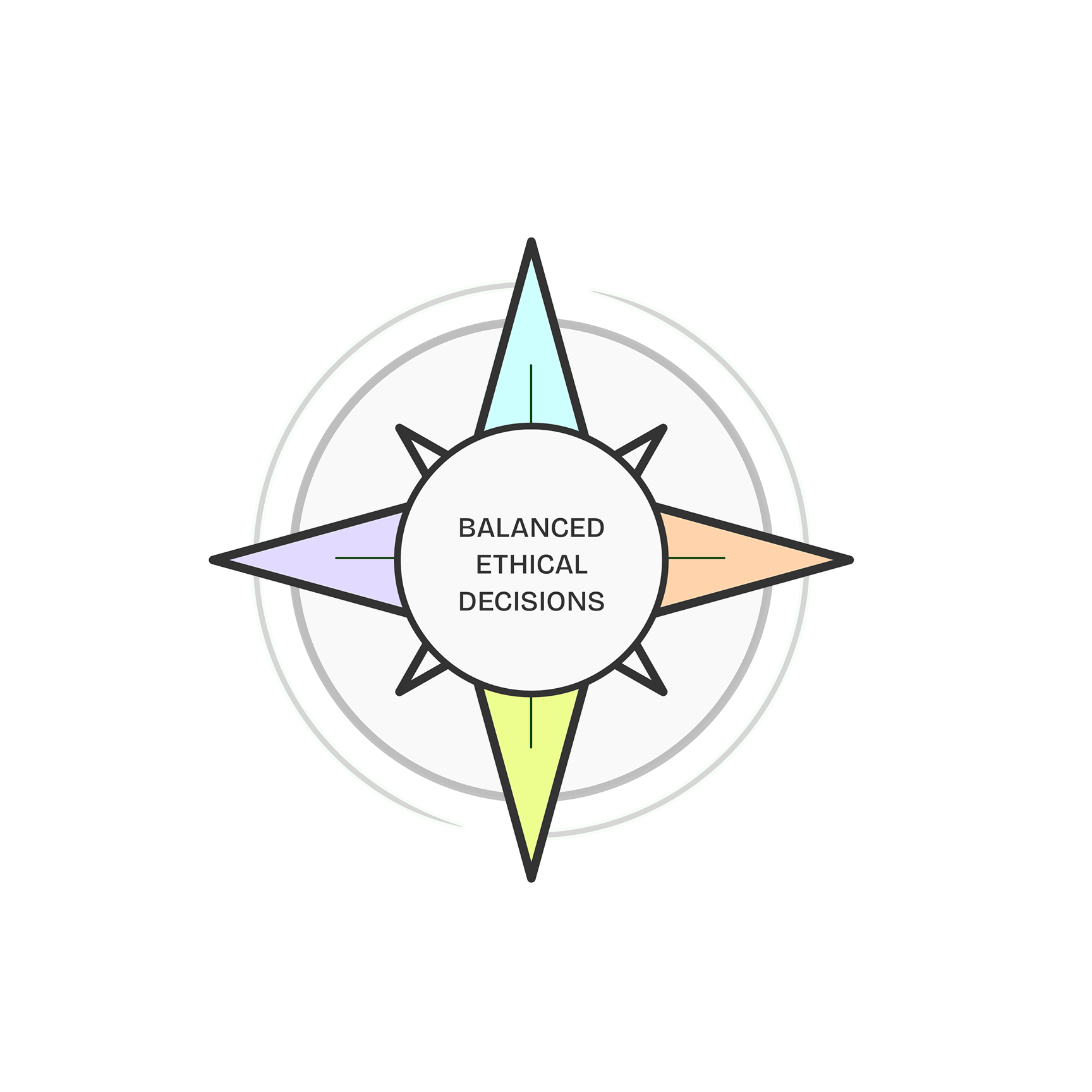
Right now, Burn out is at an all-time high. For many Americans, and for designers in particular, job opportunities are disappearing, and we’re told that AI, for all its flaws, is on track to replace us. It can feel like we’re living in a dark time – and darkness is frightening without a map.
When opportunities are scarce,
and deadlines are fast approaching,
and top-down pressure from profit-driven companies feels soul-grinding
and technology is racing toward an uncertain future,
taking a moment to pause and reflect can feel like a radical act.
And yet, we must consider:
How can we – designers, developers, thinkers – shape a sustainable future where AI is used to support, rather than diminish, human ingenuity?
What is our responsibility to our world and to each other?
As AI promises to produce deliverables faster and more cheaply than people, how can those of us in creative tech demonstrate our unique value, foster an ethos of care, and make intentional decisions about how our work is used to affect change?
The issues we face are nuanced. They vary by generation and geography. There is not a one-size-fits-all solution. But as we ask questions and engage in a discourse with experts in various fields – from designers and strategists to product developers and scientists – our aim is to plant a flag, declaring our core beliefs on what it means to be an ethical innovator in our quickly evolving world. This multi-part series will draw on interviews, research, and our own soul searching. We’re so glad that you’re here to join us.
As technological and corporate landscapes shift, the lines between designer, developer, and engineer are becoming increasingly blurred. Broadly, we see ourselves innovators. At Oliven Labs, our focus is healthcare systems and technology, but the work we do and the challenges we face have throughlines with designers across a variety of sectors. We are one pole in a big tent of creative technology experts.
Executives at the companies that hire those of us in this field – either as individuals, small teams, or larger studios – may view our work as supplemental. After all, designers are often placed under product or business on org charts. But in reality, we’re integral to a company’s vision and output.
We are bridge-builders, connecting a vulnerable population – in health care, this includes patients, caregivers, and clinicians – to corporate leadership. We represent the people who aren’t in the room, giving a voice to the voiceless in decisions that will affect their lives and wellbeing.
We are translators, integrating a diverse array of concerns, and bringing human stories to life for decision makers. We hold space for all voices – executives, operators, and end users – distilling their perspectives into a shared understanding and transforming their needs into a plan of action.
We are creators, crafting tangible, tailor-made solutions restricted only by the limits of our own imagination.
We are tight-rope walkers, balancing ROI and efficiency with the human impact of the products we ship.
We are leaders with the power to shape our future. By conceiving bold new solutions and communicating a vision based on human narratives, we can inspire our clients to take an empathetic approach and choose a path that benefits all stakeholders – not just those at the top.
We view design as a civic act. When we allow ourselves the freedom of a blank canvas, without limitations or boundaries, we have the opportunity to reshape our world and forge a path toward a more humane, sustainable future.
We are, by our nature, adaptable and it is incumbent upon us – right now – to both reimagine how best to fit into our changing world and to take up the mantle of shaping our future. Because we can. And because we must.
Increasingly, companies are using AI to improve efficiency, sometimes at the cost of quality output. As opportunities evaporate, it’s understandable to tense up. But we refuse to allow uncertainty to calcify into fear. We refuse to get stuck in a scarcity mentality.
We do not give credence to the oft-repeated warning that, in a future with unlimited automation, no one will work, because it ignores a core tenet of what drives us. We want to dream up pathways toward a more sustainable, more livable world. We want to contribute meaningfully to our society. We want to feel purpose. We want to build community. We want to surround ourselves with collaborators who will support us and challenge us as we problem-solve increasingly complex puzzles.
We are buoyed by the fact that, as designers, there are elements of our work that cannot be automated. In healthcare, the relational parts of care – understanding the full scope of the patient and provider experience, absorbing trauma, and leading with empathy – cannot be successfully managed by a machine.
We recognize the myriad ways in which AI can help us – offering the potential for extraordinary breakthroughs in healthcare, diagnosis, and research speed, plus improved access to care in rural areas. When AI is used to free us from rote execution, we can spend more time on research, synthesis, strategy, and inspiration. We can apply our judgment, storytelling ability, and systems thinking, making our work more meaningful. We can reimagine the scope of our role as designers and the very meaning of design.
As UX practitioners, we sit at the forefront of the tension between technology’s promise and deep risks – including parasocial bonds and suicidal prompts. Our work can counter tech‑driven alienation by intentionally designing for human‑to‑human connection and encouraging users to choose “conscious consumption” over default convenience. Mitigating the devastating effects of consumers’ reliance on AI is one way we can stay relevant.
We can also commit to holding up humane outcomes alongside commercial metrics to help ensure that our work is used for good. As Jaime Levy, strategist and UX pioneer, says, we can make an impact when we “design ethical products and services.”
These are some of our core beliefs which guide our decisions about which initiatives we take on and the work itself. We invite you to consider: What is your ethical code? What are the lines you won’t cross?
Over the course of your career, whether you operate within an organization or independently, you may at times feel powerless. We believe it’s important to notice where you have control.
Each of us has the power to develop an awareness of our guiding principles. Each of us has the agency to create our own ethical guardrails to serve as a north star. Ben Lengerich, professor of statistics at UW Madison and founder of Intelligible.ai says, “Deciding our value systems before we have opportunities can help us clearly see decision points down the line.”
As designers, we are taught to be peacemakers, to be unbiased, to facilitate discussions so that others can make decisions. We are asked to propose solutions, but often we are not invited to express an opinion. Nevertheless, we must not view ourselves as passive or impartial. We have a responsibility to speak up for the people who are not in the room: The end users who may never interact directly with C-suite executives. In healthcare systems, these are…
Seniors who are scared and confused, and feel like they’ve been abandoned.
Mothers of children who are sick.
Fathers who are struggling to cope.
Children with chronic illnesses.
We listen to their stories and we become vessels for their hopes and fears. As Aparna Sud, strategy manager of AI and analytics at Alvarez and Marsal says, “we hold [their concerns] in a space that is almost sacred.” While it may not always feel like it, having a seat at the table gives us significant – if invisible – power to steer discussions toward the needs of the people – the customers, the patients, the human beings whose lives will be impacted by top-down decisions and our interfaces.
We don’t have to come in looking for a fight. But we can enter the room with confidence and speak with calm authority. We can align a diverse group around a vision that prioritizes growth alongside humane outcomes. When we speak from the heart and advocate for the individuals who’ve trusted us with their personal – at times intimate – accounts, we can transform data points into three-dimensional people. Jamie Curran, independent principal CX strategist and consultant at Oliven Labs, says, “bringing those individual stories to life can help build empathy in the room.”
Executives are often under pressure to make decisions that prioritize speed and revenue at the expense of design quality and user wellbeing. Many times, by putting a human face on the consequences of their decisions, we can guide them toward a more empathetic approach. Amid concerns about the bottom line, we can help redefine value by reminding decision makers that customer satisfaction drives customer retention. Rachel Krause, director of live training at NNGroup (NN/G), says, “When we advocate for users, we’re steering the business toward outcomes that last. User satisfaction is the foundation of loyalty, and loyalty is what keeps a business alive.” So, long term, human-centered solutions are good for business.
Of course, there may be times when decision makers simply cannot be swayed. If a path is chosen that ignores user data, or deprioritizes insight integrity, or overly automates a process that requires human-to-human interaction and will ultimately harm people, we have the power to say no. We have the power to walk away. Sometimes that is all we can do. Perhaps someone else will take up that vision where we leave off, but if each of us sets down an ethical code guarded by sturdy boundaries, then a single “no” can reverberate – loud.
As companies race toward infinite growth and as new generations of AI models emerge, it will become increasingly difficult for individuals to stem the tide of suboptimal business practices in the name of “efficiency.” Experts like Jamie Curran argue that government regulation is the main pathway for ensuring that design serves people and not just the bottom line. Of course, political action requires popular will, so we ask –
Let us come together and use our collective voice to call for regulation.
We need data and privacy restrictions,
licensing requirements,
transparency policies, and
economic policies that protect creative jobs and
incentivize companies to use automation where it functions best and to
prioritize the sustainability of our planet.
Together we make our voices heard in the halls of power.
We are realistic that collective action takes time. Wins may be incremental. So as we work toward regulatory frameworks that will protect our jobs, our privacy, and our planet, we want to simultaneously look to our community and ask:
How can we, as designers, create a shared ethos and hold each other to account?
Unlike engineering, design has no formal code of ethics or licensure, yet the impact of our work is profound. We believe in bringing ethics to the foreground, and making it a daily practice as we examine the impact of our products and consider the ripple effects of our decisions. We feel that having fixed standards across our field will make it easier to hold ourselves and our clients to account. We urge our community – across all sectors and all nations – to come together and interrogate how to weave empathy and integrity into every stage of design.
.png)
We know that it is no small task to get the global community of designers and strategists to agree on a unified ethical “QA” standard. But then, isn’t that type of intricate problem solving what we do best?
The present moment is rife with difficult questions: How can we adapt to our changing landscape? Where do we fight back, and where do we look for new doors in the maze? How do we cope in a time of great uncertainty?
We cannot meet the present moment with an old set of strategies. Now is the time to expand our aperture and put our talents to use. As a community, we have unique potential to protect the soul of our society and transform our world.
We take inspiration from Bruce Mau’s belief that design is a leadership act – not an aesthetic one – that has the power to reshape the conditions of life itself. As designers and strategists, we have a responsibility, and an opportunity, to think big. To release preconceived notions on the limits of our role. To start with a blank canvas. To slow down, and ask questions:
When we rethink the systems that are currently in place and examine what really matters in our work, our lives, and our environment, what can we build?
How can we devise solutions that benefit businesses, consumers, and workers?
How can we craft a sustainable path forward that uses automation to enhance prosperity while protecting our planet?
How can we design a more just world?
We do not have all the answers – no one person could. That’s why we want to build a coalition with other designers, engineers, and thinkers who believe that even in the darkness of uncertainty there is reason to hope. We want to gather our voices together, hold space for all of our concerns, and use our collective expertise to create a roadmap for a livable future. We need each other now more than ever.
This is a call to action. This is a rally cry. This is an invitation.
The Oliven Labs Manifesto came together through our own soul searching and through conversations with experts we respect. Our contributors include:
Kristine Howell
Founder and Principal, Oliven Labs
Kristine Howell is the founder and principal of Oliven Labs, a healthcare UX strategy studio that partners with health systems, payers, and health tech innovators to design research driven, outcomes focused digital experiences. A certified NN/g UX strategist with more than 20 years leading healthcare experience design, she builds and guides cross functional teams that weave product strategy, AI enabled operations, and UX into solutions that untangle complex clinical workflows, payer dynamics, and end to end patient journeys.
Aparna Sud
Strategy Manager, AI and Analytics
Aparna is a strategy leader in the AI and Analytics group at Alvarez and Marsal, where she helps organizations translate AI ambition into practical, human centered transformation. Drawing on a background in neuroscience, management, and strategic design, she has led customer experience and digital transformation initiatives and advised corporate and startup clients on brand, experience, and AI readiness. She holds a dual BSc in Neuroscience and Management from the Massachusetts Institute of Technology and a masters degree in Strategic Design and Management from Parsons School of Design.
Jaime Levy
Strategist, Instructor, Author, New Media Artist
Jaime Levy is an American author, new media artist, interface designer, and user experience strategist who has been a pioneer in digital media and UX for more than three decades. She first became known in the 1990s for experimental new media projects, including electronic magazines like Cyber Rag and Electronic Hollywood, interactive work for Billy Idol’s Cyberpunk album, and the online magazine WORD. She is the author of the influential book UX Strategy, widely regarded as a foundational text on the practice of user experience strategy.
Jamie Curran
Principal CX Strategist
Jamie is a seasoned UX researcher, design strategist, and team leader with over 15 years of experience at the intersection of technology, design, and human insight. She has served as a leader at Deloitte Digital, guiding multidisciplinary teams and executive clients most notably within healthcare systems and delivering measurable impact through experience driven innovation. She holds a B.S. in Mechanical Engineering from MIT and a Master’s degree in Integrated Innovation for Products and Services from Carnegie Mellon.
Ben Lengerich
Professor + Founder of Intelligible
Ben Lengerich is an assistant professor of statistics at the University of Wisconsin Madison and founder of Intelligible.ai, where he develops machine learning methods and AI systems to advance precision medicine and real world evidence generation. His work builds on prior research as a postdoctoral associate at MIT CSAIL focused on AI for healthcare and single cell omics, and a PhD in computer science from Carnegie Mellon University.
Rachel Krause
Director of Live Training, NNGroup
Rachel Krause is the Director of Live Training at NNGroup. She leads the design, delivery, and continuous improvement of NN/G’s live training offerings. She has expertise in UX strategy, facilitation, storytelling, product design, and stakeholder management, and is passionate about empowering UX professionals to build skills, solve complex problems, and elevate UX maturity within their organizations.
Brittany Bookbinder
Writer
Brittany Bookbinder, a screenwriter based in Los Angeles, believes audiences crave compelling characters and cliff hangers in their brand stories too. With a diverse range of experiences from copywriting to podcast production, she has written dozens of blog posts and newsletters for companies including DM Training, Bright Cellars, and the Daily Dig. She holds an MFA in Screenwriting from USC and has worked as the writer’s assistant/showrunner’s assistant on SMOKE, a drama series on Apple TV+ and a new drama series for Netflix.
Lotti Lofgren
Chief of Staff, Oliven Labs | Founder, UN|STUCK Coaching
Lotti Lofgren has carved a path at the intersection of resilience, self-discovery, and human potential. As the Chief of Staff at Oliven Labs and PCC ICF-accredited Life Coach, founder of UN|STUCK Coaching, she draws on a remarkably diverse background, both personally and professionally, to help people reconnect with who they truly are. In a world increasingly shaped by intelligent systems, she reminds us that the systems we build are ultimately a reflection of who we are.
Want to join us as a thought partner for our next article series?