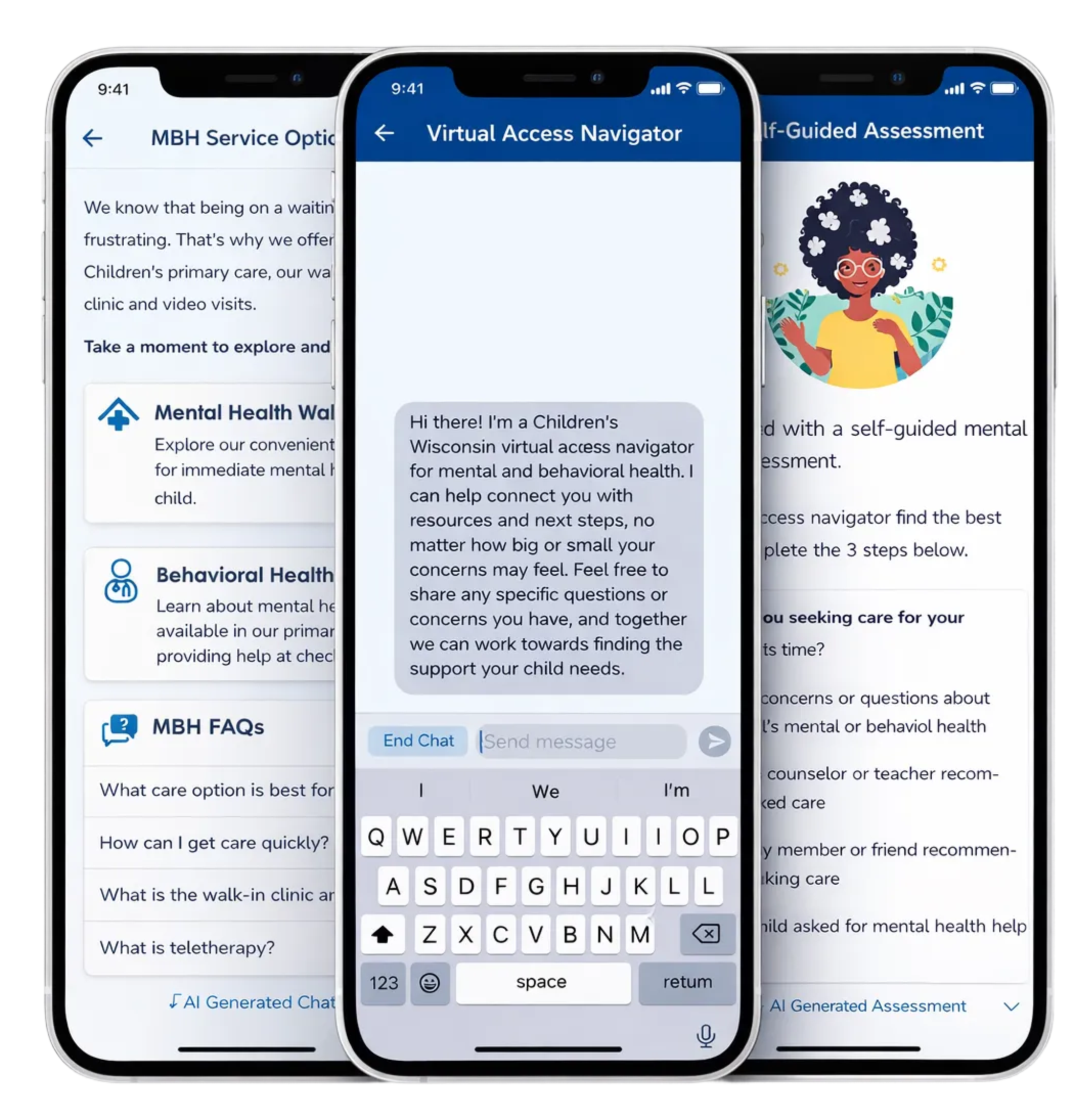
Expanding pediatric mental and behavioral health access across Wisconsin, cutting waitlists by 96% and doubling the number of children served through research-led walk-in clinics and digital innovation.


Hands-on partnership allowed for quick, comprehensive solutions, sharing expertise in real-time, and building the team's capacity to sustain innovation beyond our engagement.
Designed stigma-sensitive research capturing authentic voices from diverse families, including those often left out. Deeply listening to real experiences uncovered not just what families need, but why they struggle to get help.
Combined survey data with in-depth interviews to identify critical patterns: where walk-in clinics would have the greatest impact in a landscape with months-long waits, what barriers prevent families from seeking early help, and how to reach them effectively, turning insights into action.
Deep healthcare knowledge ensured the right questions were asked, findings connected to real clinical challenges, and solutions that worked within real-world care systems.
Children's Wisconsin's Mental and Behavioral Health Department provides expert care for children and teens statewide. They treat conditions ranging from common struggles to complex psychiatric issues, with award-winning care coordination and ongoing expansion of services. A transformative contribution came from Jeff Yabuki, whose $20 million gift from the Yabuki Family Foundation allowed the department to expand its reach and enhance the scope of mental and behavioral health services for children and families. This pivotal support has powered large-scale innovation, making the department a statewide leader in pediatric mental health care and directly advancing accessible, quality treatment for more young people.
“The Oliven Labs team’s expertise and perspectives were extremely valuable throughout the process. Together, we created a vision enriched by their leadership in showcasing patient needs. They were true partners every step of the way.”
Jeremy White
Manager of Experience Insights & Design
Children's Wisconsin
Wisconsin continues to face soaring demand for children’s mental and behavioral health (MBH) support, with 6-9 month long waitlists and urgent needs often falling to generalists in ERs and pediatricians. Our challenge, and opportunity, was to expand service accessibility by identifying the most impactful clinic locations to launch walk-in MBH care where families could get same-day, barrier-free help. This groundbreaking, system-wide initiative set a new standard for immediate, anytime access to care, covering every trigger point in a child’s care journey, and ensuring every child received mental health support whether facing a crisis or seeking routine support.


No child turned away from the mental health care they need.

250,000 children in Wisconsin need mental health support annually
Growing year-over-year demand for mental and behavioral health services in Wisconsin was far exceeding availability, resulting in waitlists as long as nine months for psychiatric care.
48% rise in mental health struggles for WI high schoolers over last 8 years
With only 21% of youth receiving mental health care and 41% more high schoolers considering suicide, children need pediatric crisis resources designed for their needs, not emergency departments that add to their distress.
1.5 million Wisconsinites live in mental health professional shortage areas
Bridging the disconnect between family experience and system capacity required clearer, more inclusive pathways into care and stronger regional insight to guide services to the communities with the greatest impact.
Oliven Labs embedded with Children’s Wisconsin’s experience and MBH leadership teams to conduct comprehensive research on expanding pediatric mental health access. Through surveys and in-depth family interviews, priority impact locations were identified, as well as how to increase awareness of walk-in clinics, and what barriers prevent families from seeking help. These insights informed a rapid design sprint and a digital solution that not only bridged, but scaled MBH care access, turning research into actionable strategies and voice-of-patient–driven decisions.
.png)

Quantitative surveys paired with 1:1 interviews to go beyond standard metrics and uncover real barriers, stigma, and personal challenges families face when accessing mental health care. This iterative, mixed-methods approach provided a richer understanding and concrete insights for strategic action.

Final reports distilled insights into executive-facing presentations to empower leaders to take action by revealing the emotional and practical realities of accessing services, identifying locations needing the most support, and aligning with the MBH team's strategy to maximize Yabuki fund impact and improve satisfaction at every touchpoint.

Prototyped a mobile-optimized, no-dead-end intake process, in 2 weeks, combining traditional forms and conversational AI, tested with families to improve touchless completion rates, guide caregivers through services, and ensure timely support at critical points in a child’s mental health journey.

Integrated healthcare UX expertise, emphasizing stigma-sensitive research and accessibility, springboarding prioritized initiatives to accelerate internal capabilities and deliver innovation faster.

Identified a cross-section of socio-economic and racially diverse patient families, then created accessible surveys to ensure families from every background could share authentic perspectives.

92% of families without a previous MBH relationship saw value in the walk-in clinic model, which now provides a clear, welcoming entry point for initial evaluations, expanding access for those seeking help for the first time and throughout the care journey.
Research confirmed the need for a multi-tiered system with simple navigation for routine concerns, rapid escalation for crises, and flexible entry points to ensure every child could access care, regardless of severity.
The walk-in clinic model, with streamlined pathways and flexible intake options, reduced the waitlist by 96% and doubled patient capacity, providing families convenient, stigma-sensitive access at critical moments by dissolving logistical, cultural, and emotional barriers.
Research identified priority communities with the greatest need and least access, enabling Children's Wisconsin to strategically position walk-in clinics where they would have maximum impact, ensuring underserved populations received equitable access to same-day mental health care.
Oliven Labs' research gave Children's Wisconsin a clear roadmap to transform pediatric mental health access, and the results demonstrated system-wide change. Wait times dropped 96% while the team doubled patient capacity without sacrificing quality. Children connected with hospital therapists at 92% higher rates. Behavioral health consultant touchpoints in clinics surged 1100%. The mental health center answered 93% more calls from families seeking help.
The digital prototype reinforces this expansion by giving families a guided pathway to walk-in and scheduled services at critical moments, reducing confusion and stigma around seeking care. Together, these solutions enable a fundamental shift: from managing crises to preventing them, ensuring children receive support before small struggles escalate into emergencies.