
Healthcare leaders are not short on data. Claims, clinical notes, eligibility files, call-center transcripts, pharmacy feeds, and survey results pile up faster than any team can use them. What most organizations are short on is decisions they can trust.
That gap is now showing up in AI results. Writing in Harvard Business Review, David De Cremer points to an MIT report finding that 95% of generative AI projects fail, and to a National Bureau of Economic Research survey of more than 6,000 senior executives in which roughly 90% reported no measurable productivity gain from AI over the past three years. His diagnosis is blunt: the technology works. "The problem is how leaders think about it." (HBR, July 2026)
In healthcare, that thinking problem has a very specific shape.
In a March 2026 HBR article, Amber Nigam and John Glaser describe what happened when they used generalist large language models to review charts for prior authorization. One model denied a knee MRI because it found no record of the six weeks of physical therapy the policy required. It missed that the chart documented a prior ACL repair, which under that same policy qualified the patient for immediate imaging. Another model overlooked a positive Hoffman's sign in the neurological exam, a finding any clinician would read as a red flag for spinal cord compression. (HBR, March 2026)
The models read every word. They just did not understand what the words meant together. As the authors put it, healthcare communication is really dozens of specialized dialects, each with its own logic and unstated assumptions. Their recommended fix is a step most organizations skip: systematic dialect mapping with domain experts before anything is deployed.
That is not only an AI lesson. It is a data strategy lesson. The same failure shows up long before a model is involved, in dashboards and reports where one word quietly carries several meanings.
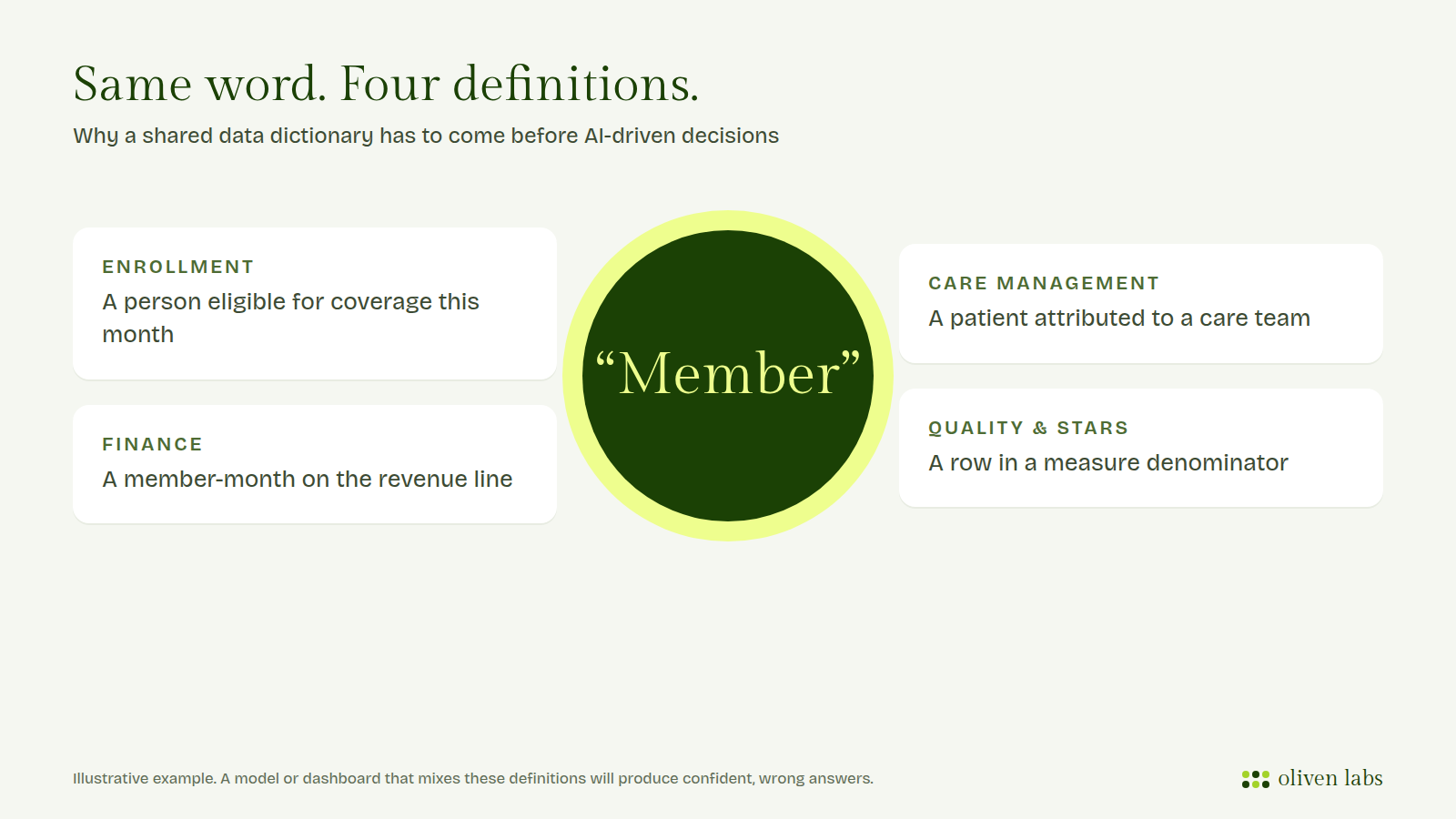
When enrollment, finance, care management, and quality teams each count "members" differently, every downstream number inherits the confusion. Put an AI model on top of that and you get faster, more confident versions of the same wrong answer.
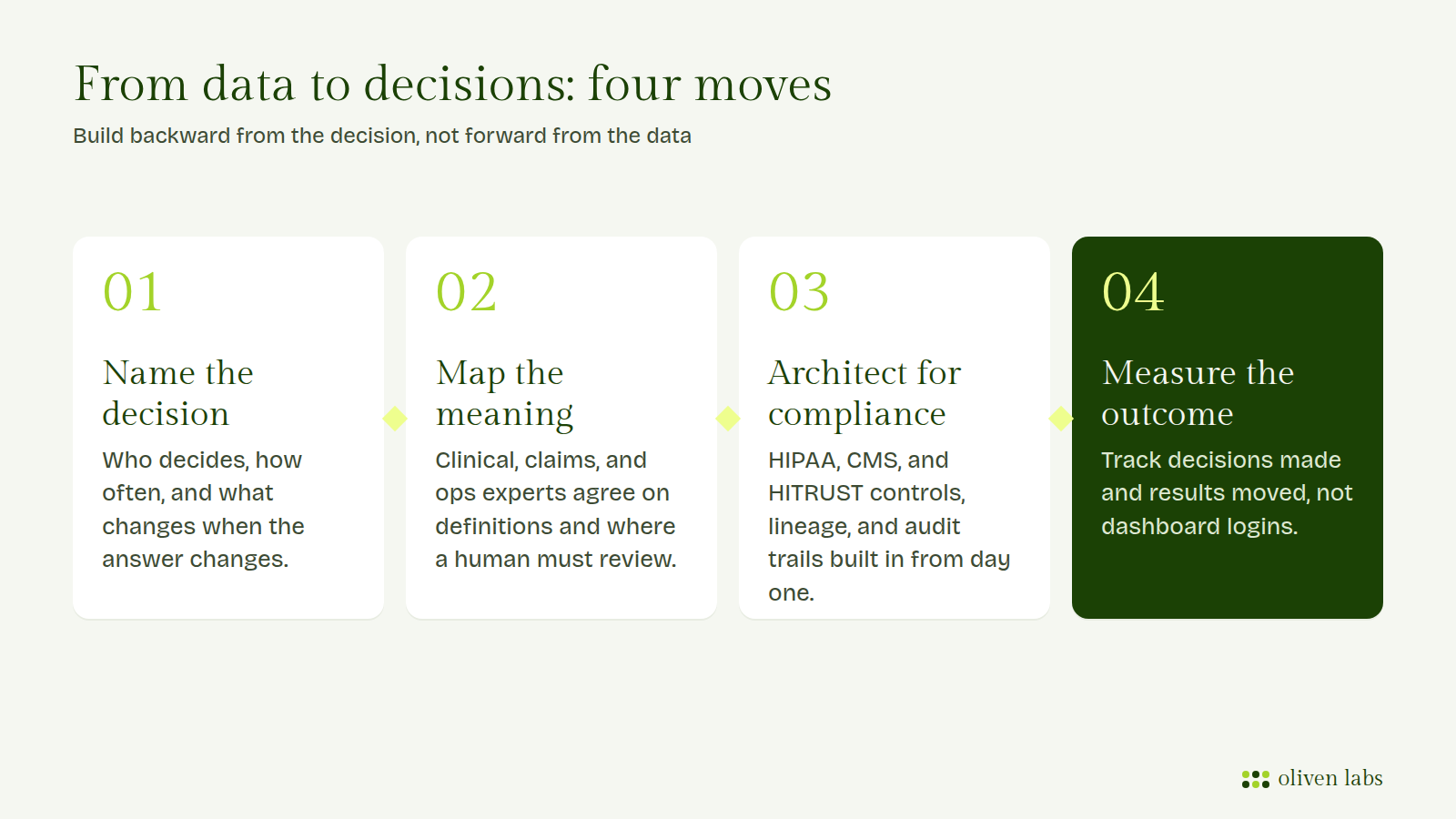
The organizations that get real value from healthcare data tend to work backward from the decision rather than forward from the data. In our work with payers, providers, healthtech, and life sciences teams, four moves make the biggest difference.
Getting the meaning right does not mean slowing down. Many healthcare decisions happen inside short windows, and a monthly report often arrives after the moment has passed. During Medicare Annual Enrollment, for example, a plan has weeks to spot and respond to problems, not quarters.
That is why we built Active Analytics, a first-to-market intelligence platform for continuous plan monitoring at Medicare Annual Enrollment scale. It pairs real-time clinical and claims feeds with shared definitions and human validation, so teams can act while the window is still open. You can read more about this work on our Healthcare Data Strategy page.
If you are planning a data or AI investment in the next year, ask your team five questions:
If more than two of those answers are unclear, the problem is probably not your technology.
Oliven Labs builds custom healthcare analytics platforms and decision intelligence for enterprise healthcare organizations. Our embedded senior teams span UX, engineering, AI, analytics, and product management, so strategy and execution never get lost in a handoff. Across our platforms we have analyzed more than 85 million clinical, claims, and operational data points and delivered more than $100 million in measurable revenue impact.
Ready to turn your data into decisions? Let's talk about your healthcare data strategy.
Figures from HBR articles are attributed to their authors. Oliven Labs results are drawn from olivenlabs.com.
Want to join us as a thought partner for our next article series?