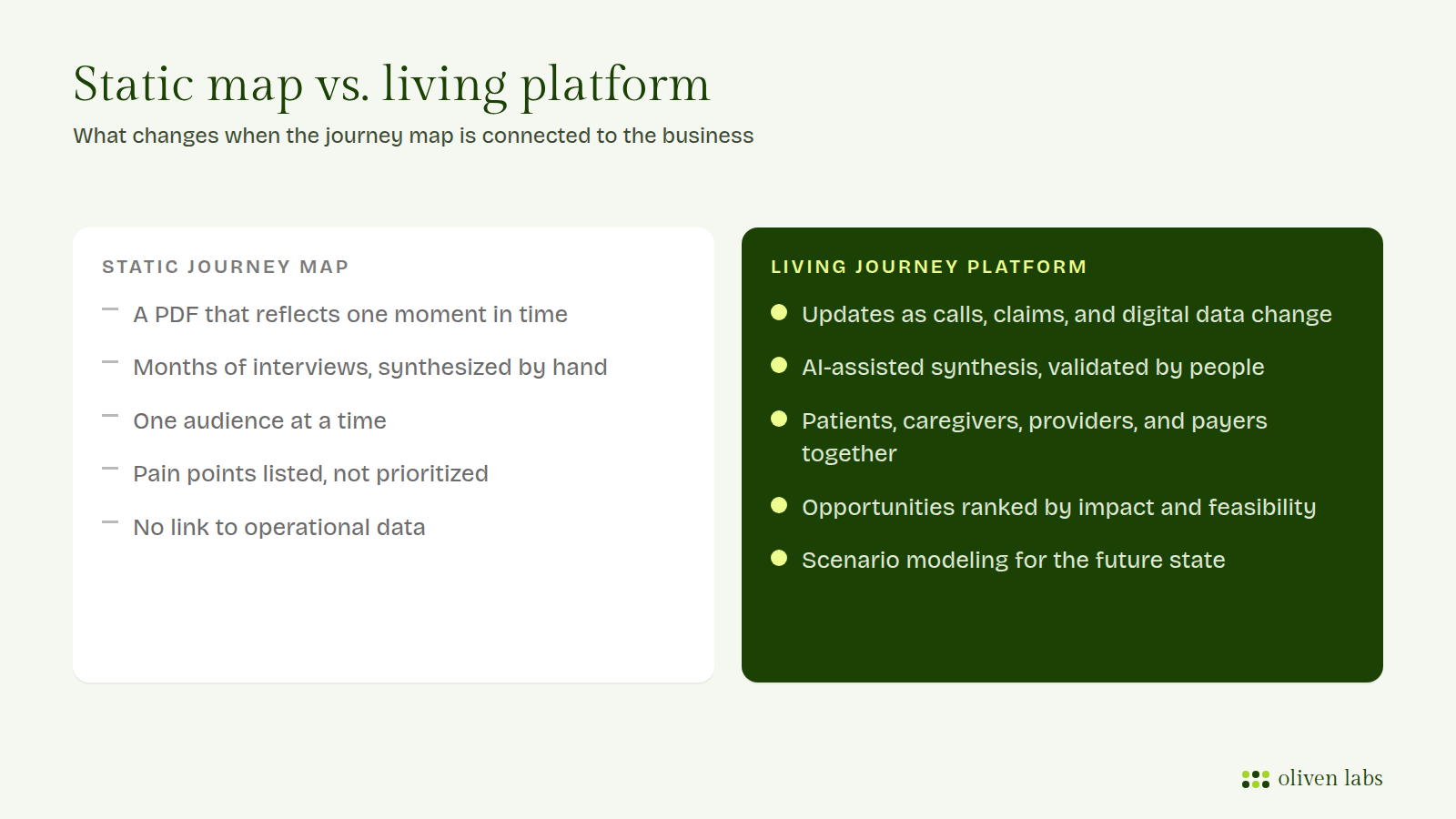
Most healthcare organizations have a journey map somewhere. It is usually a well-designed PDF, produced after months of interviews, presented at an offsite, and saved to a shared drive. Six months later the benefit design has changed, the portal has been redesigned, and a new vendor handles outreach. The map still describes a journey that no one takes anymore.
The research behind those maps is often excellent. The problem is the format. A static document cannot keep up with a system that changes every quarter, and it cannot coordinate the many teams who each own a piece of the experience.
In the September–October 2026 issue of HBR, Kris Johnson Ferreira and Jordan Tong describe why enterprise decisions stall. The decisions that matter most span functions. The knowledge needed to make them is spread across teams, and much of it "exists only in people's heads," surfacing late and forcing plans to be reworked again and again. Their conclusion is that these delays are not a sign of bad management. They are a sign that the organization has outgrown its ability to coordinate decisions by hand. (HBR, Sept.–Oct. 2026)
Healthcare journeys are a textbook case. Think about a member waiting on a prior authorization. That one experience touches utilization management, the provider network, the call center, digital, pharmacy, and sometimes the employer. No single team owns it. A journey map can document the frustration, but on its own it cannot bring those teams together to fix it.
Ferreira and Tong also found that people add the most value not by competing with AI but by contributing what it cannot see: tacit knowledge, changing constraints, and context. That is exactly the balance a modern journey platform should strike.
A second recent HBR article adds an important layer. Pengxiang Zhang, Eric Yanfei Zhao, and Sali Li argue that most customer-listening systems pick up two signals: what customers want and how they feel. They often miss a third: when customers expect action. The authors call this temporal urgency. (HBR, August 2026)
In healthcare, this distinction can be the difference between a minor annoyance and a lost patient. A member who says "I will sort out the bill later" and a caregiver who says "we have called three times and his refill runs out Friday" may register the same frustration score. Their action horizons could not be more different.
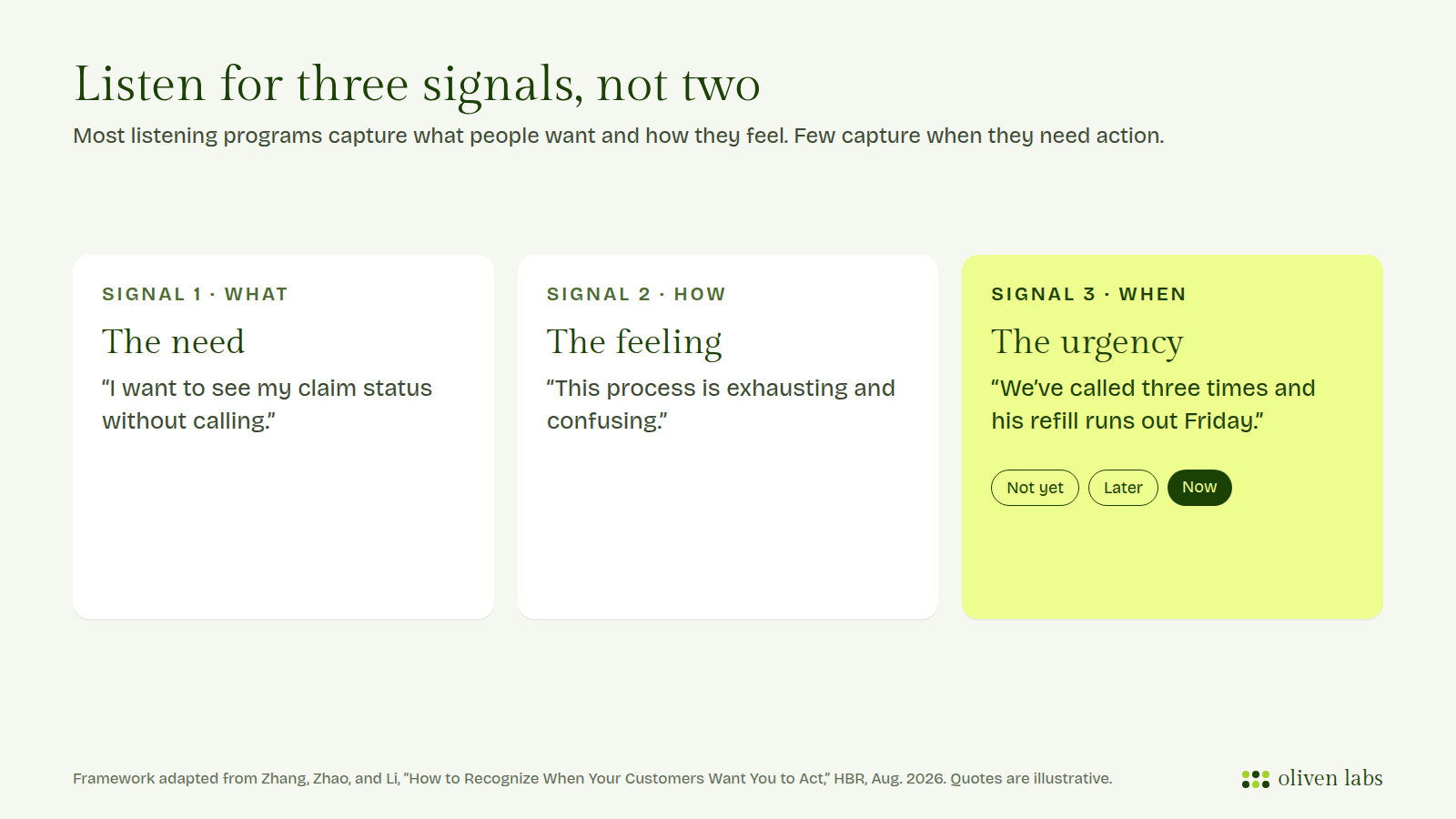
A living journey map should tag moments not only by pain and sentiment but by urgency, so teams can tell the difference between a roadmap item and a problem that needs attention this week.
The shift from static to living is less about software and more about how the map is connected to the business. In practice that means:
When we replace static maps with a living platform, clients typically see journeys created up to 90% faster, insights synthesized 10 times faster, three times as many validated opportunities, and 40% fewer assumptions in their roadmaps. In one pediatric behavioral health engagement, journey work helped reduce a mental health waitlist by 96%.
Getting started does not require a multi-year program. A focused four-week pilot on a single high-cost journey is usually enough to show the difference.
Oliven Labs replaces static journey maps with a living, AI-powered platform for healthcare leaders across payers, providers, healthtech, and life sciences. We combine human-centered research, HIPAA-compliant data integration, and an embedded team that works alongside yours. Learn more on our Journey Mapping page.
Ready to see your journey as it is today? Let's talk about a four-week pilot.
Figures from HBR articles are attributed to their authors. Oliven Labs results are drawn from olivenlabs.com.
Want to join us as a thought partner for our next article series?