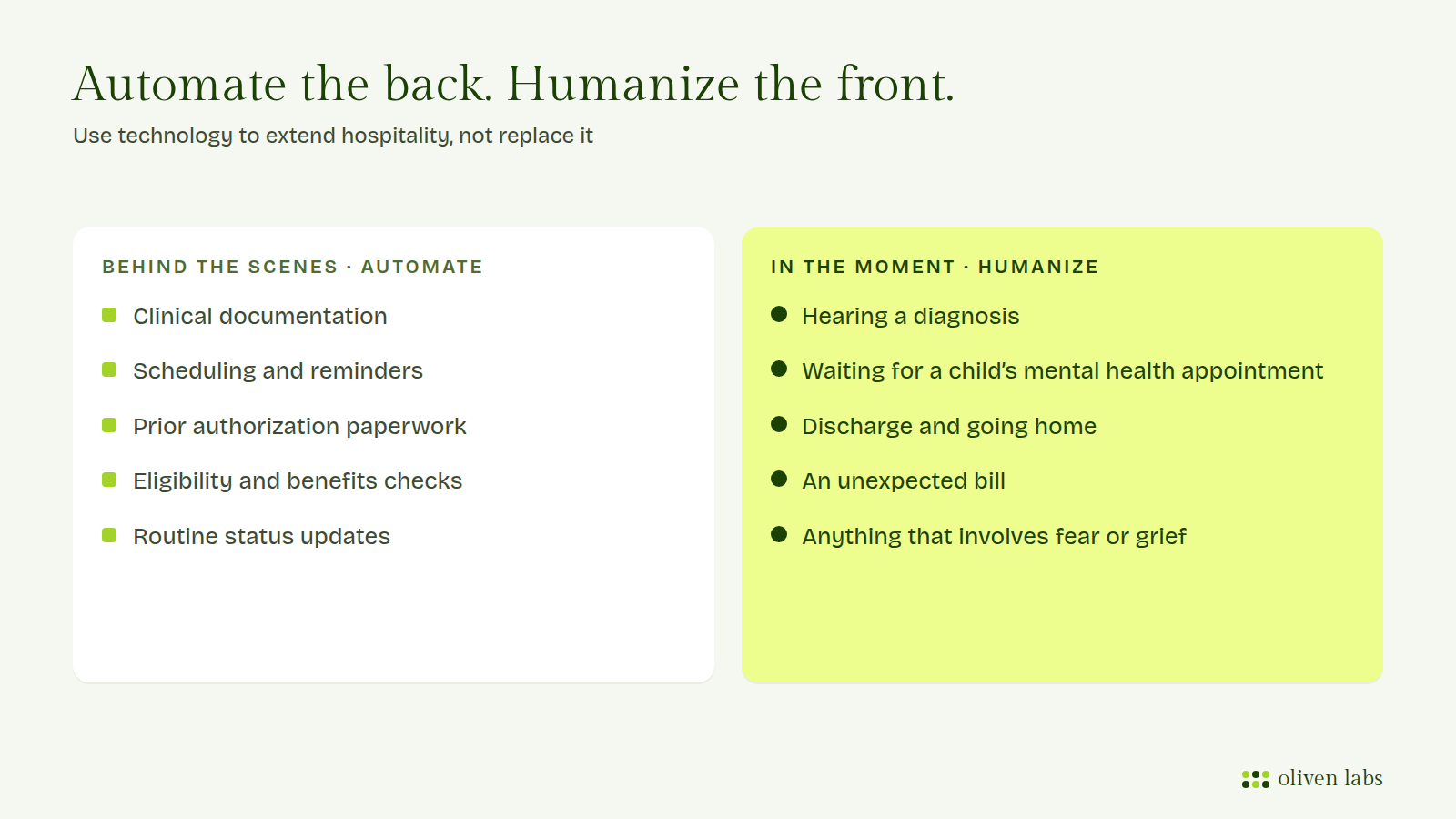
Health systems are investing in AI faster than ever, and much of it is aimed at the work patients never see: documentation, scheduling, coding, and prior authorization. That is good news. But it raises a question most strategies skip: once technology gives time back, what happens to it?
The answer will decide which health systems patients choose, recommend, and return to.
In the November–December 2025 issue of HBR, Advocate Health CEO Eugene Woods describes how the system is deploying AI at scale. Advocate is the largest U.S. healthcare user of Microsoft's DAX Copilot, an ambient tool that turns visit audio into clinical notes and saves many of its 21,000 physicians up to an hour a day of administrative work. With imaging partner Aidoc, radiologists can now diagnose brain bleeds in under three minutes, down from 25. Woods frames AI as an investment "to help revive humanity in medicine." (HBR, Nov.–Dec. 2025)
That framing matters. The value of saved time depends on where it goes next.
A February 2026 HBR article by Horst Schulze, co-founder of Ritz-Carlton, and Micah Solomon offers a useful lens from outside healthcare. When Four Seasons built its guest app, the team resisted turning it into a pure transaction machine. Guests could text requests, but there was always a real person on the other end. The principle was to use technology to extend hospitality, not replace it. (HBR, February 2026)
The authors also warn that relentless efficiency metrics, such as measuring call-center handle time to the second, can squeeze out the space for real connection. The best hospitality companies are highly efficient behind the scenes precisely so their people can focus on guests.
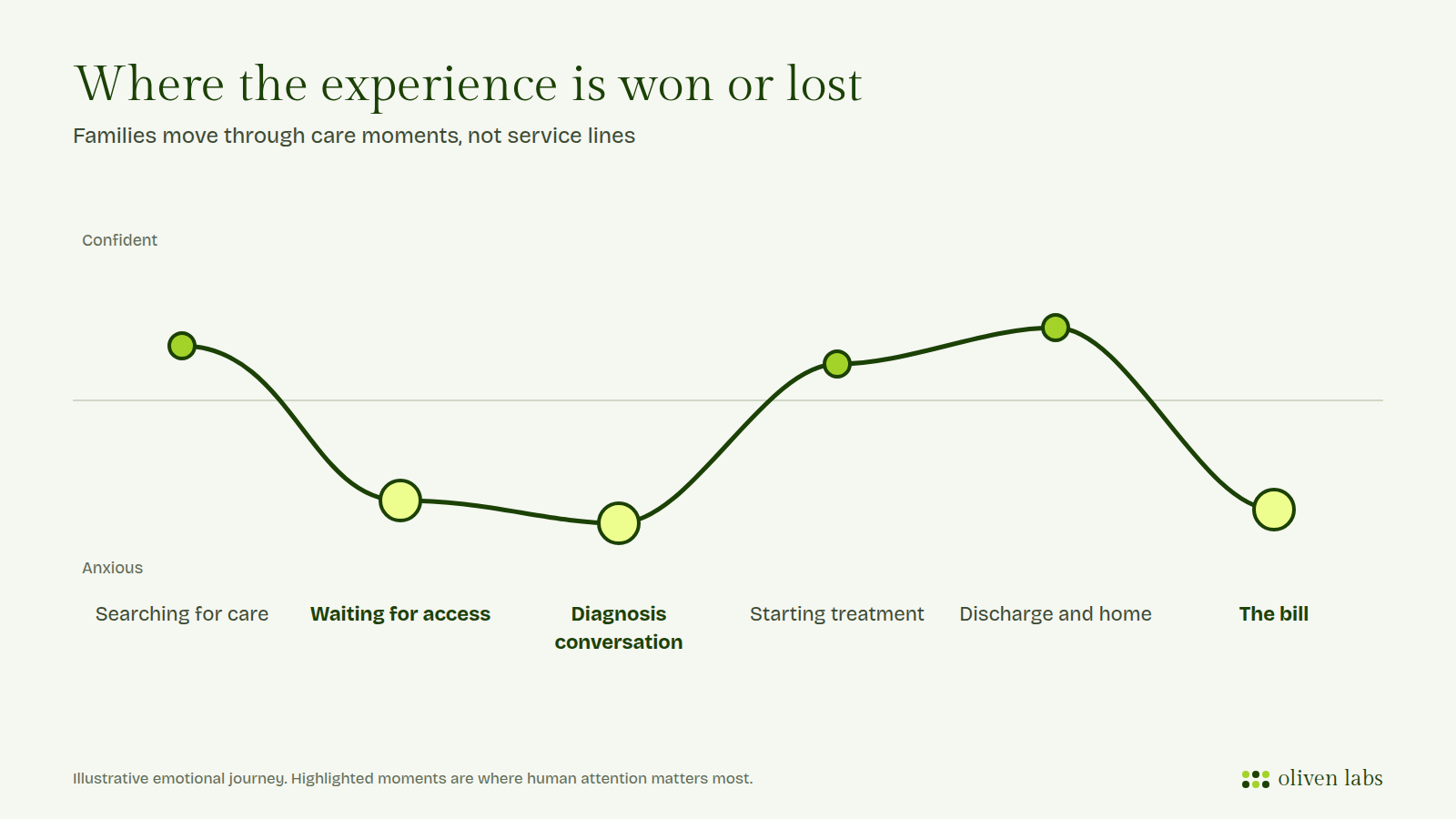
For many families, the hardest part of care is getting in the door. That is especially true in pediatric and behavioral health, where long waitlists can turn a manageable need into a crisis.
In our work with health systems, we have seen how much experience strategy can change access. In our pediatric mental health work, research-led redesign helped cut one waitlist by 96%, and expanded access has doubled the number of patients served. That work rests on deep listening: more than 100 one-on-one interviews to understand why families delay care and what they fear most.
Oliven Labs helps health systems make patient experience a competitive advantage. We combine AI-powered patient and family journey mapping, psychographic research, and experience measurement frameworks, with deep specialization in pediatric and behavioral health. Our engagements are built around outcomes, not hours. Learn more on our Health System Patient Experience page.
Ready to make patient experience your unfair advantage? Let's talk.
Figures from HBR articles are attributed to their authors. Oliven Labs results are drawn from olivenlabs.com.
Want to join us as a thought partner for our next article series?