
Life sciences companies have never had better digital tools. Analytics hubs, AI copilots, CRM platforms, and patient apps are all in place. Yet many leadership teams still struggle to answer a basic question: what did we get for it?
In a February 2026 HBR article, Prabhakant Sinha, Arun Shastri, and Sally Lorimer cite a 2026 ZS survey of U.S. pharmaceutical chief digital and information officers. Fewer than half reported measurable value from their commercial AI efforts. The barriers they named were familiar: fragmented data, unclear ownership, and limited change management. The authors also note a 2025 PwC survey in which 56% of CEOs said they were not yet seeing financial returns from AI. (HBR, February 2026)
Their central argument is that companies that succeed treat digital as an operating-model transformation, not a technology upgrade. They make four connected shifts.
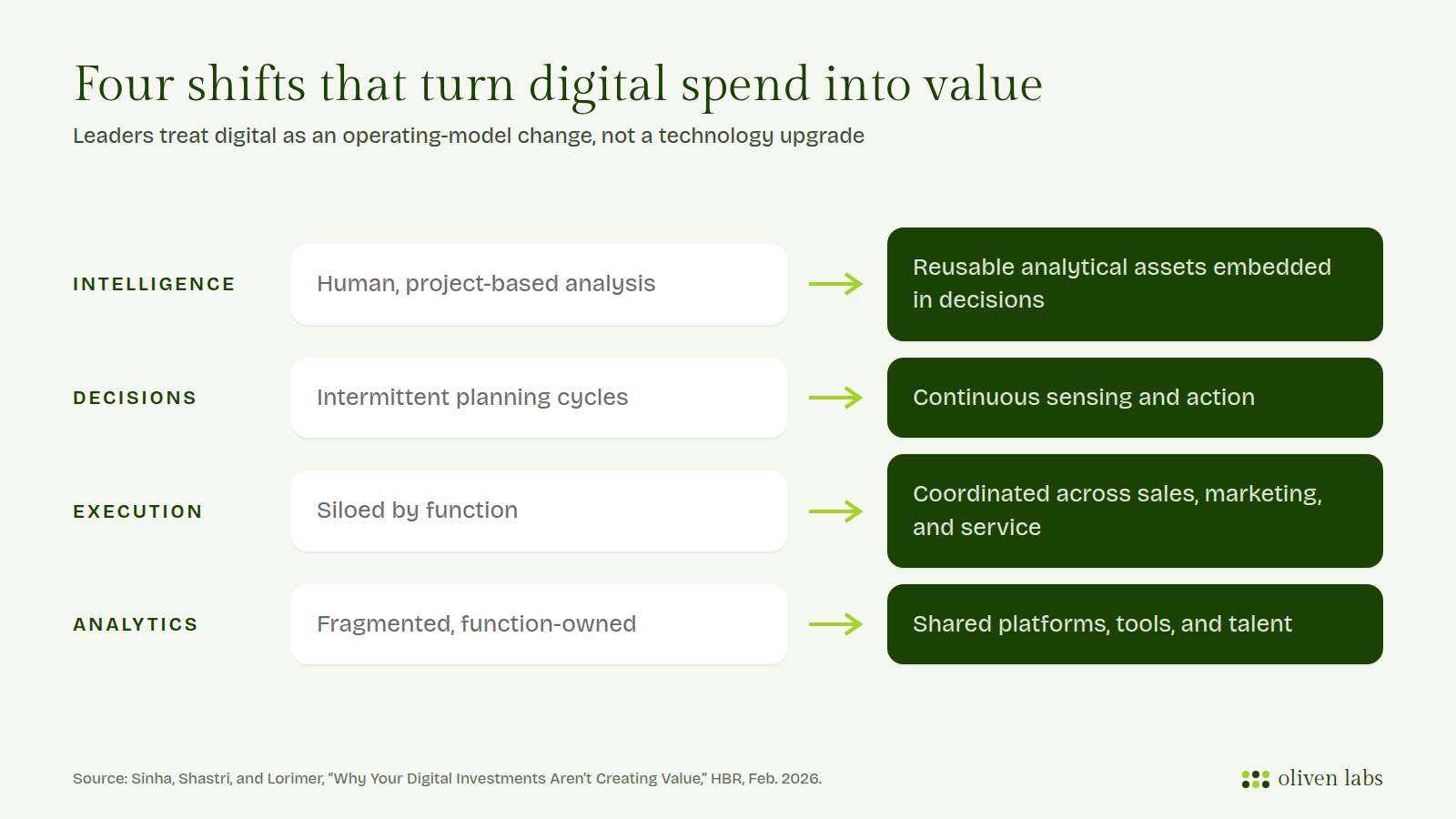
One example in the article stands out for life sciences. At Takeda Oncology, sales teams once worked from static monthly call plans. Today a system continuously senses changes in individual patient journeys, so representatives can deliver relevant information to oncologists when a treatment decision is actually being made. That is a digital investment tied directly to a real-world decision.
Speed is becoming a strategic issue, not just an operational one. In an April 2026 HBR article, Anaeze Offodile and colleagues describe how quickly China's pharmaceutical R&D sector has grown. They report a 641% increase in drug development programs over the past decade, and note that drugmakers are increasingly partnering with Chinese hospitals on trials that are roughly 40% less expensive and 50% faster. (HBR, April 2026)
When the science moves that fast, the digital products around it cannot take 18 months to ship. Patient support programs, HCP portals, diagnostic ordering flows, and results delivery all need to launch within the regulatory and commercial windows that matter.
Life sciences digital products are rarely built for one user. Take a molecular diagnostic. The ordering physician needs fast ordering and clear, actionable results. The patient needs to understand cost, logistics, and next steps. The lab needs clean specimen and order data. The payer needs evidence of clinical utility. Regulators shape all of it.
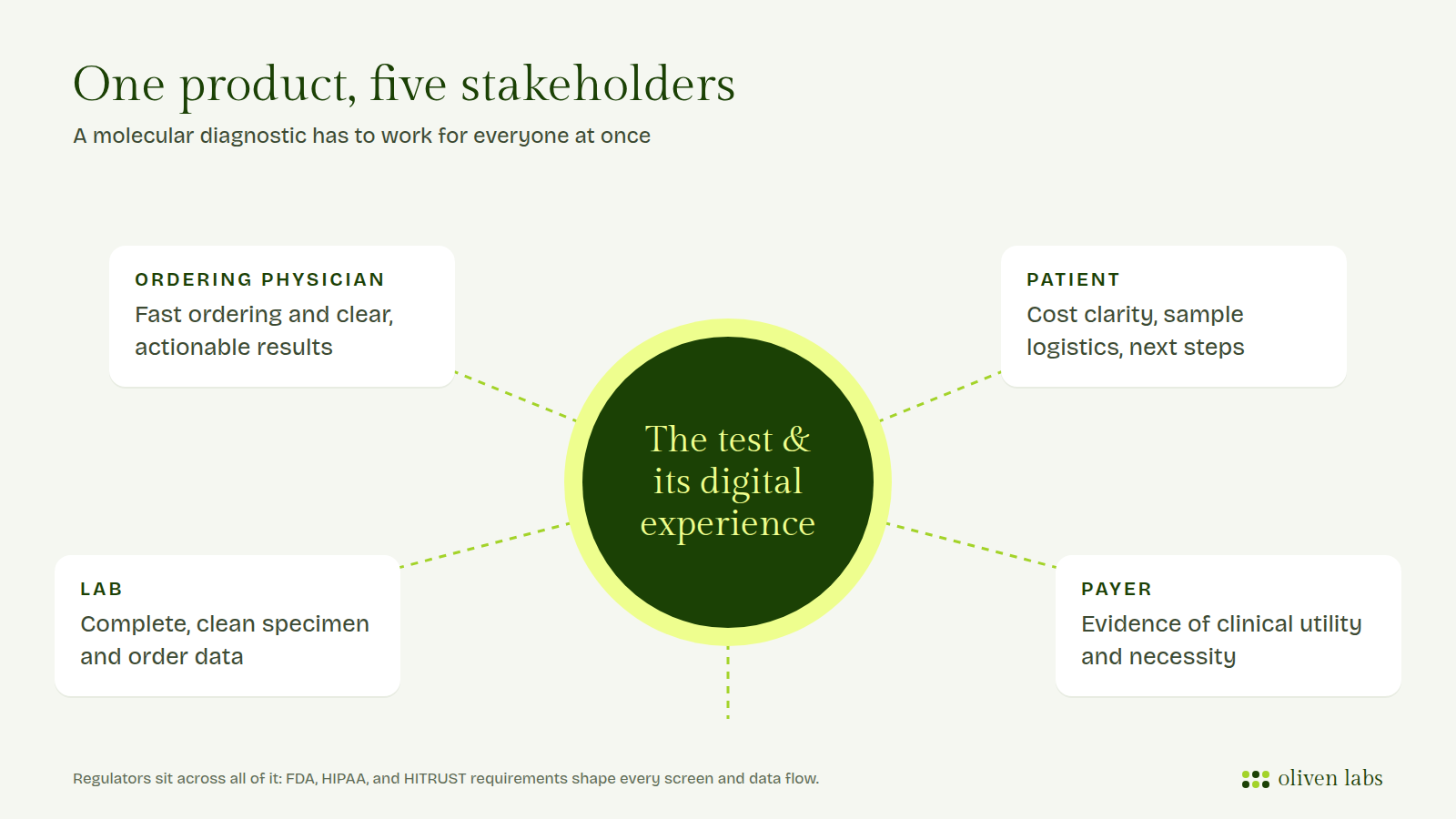
Design the experience for only one of those groups, and it becomes friction for the others. That friction shows up as abandoned orders, delayed reimbursement, and lost trust.
Based on our work with molecular diagnostics, biotech, and pharma teams, four practices close the gap between digital spend and value:
Oliven Labs helps life sciences companies ship digital products that earn regulatory, commercial, and patient trust. Our embedded teams combine multi-stakeholder strategy, regulated product design, and AI-powered journey mapping. Clients have seen time-to-delivery up to six times faster than industry norms and 40% savings in customer success time, with a 100% regulatory compliance track record. Learn more on our Life Sciences Digital Strategy page.
Ready to turn digital investment into measurable value? Let's talk.
Figures from HBR articles are attributed to their authors. Oliven Labs results are drawn from olivenlabs.com.
Want to join us as a thought partner for our next article series?